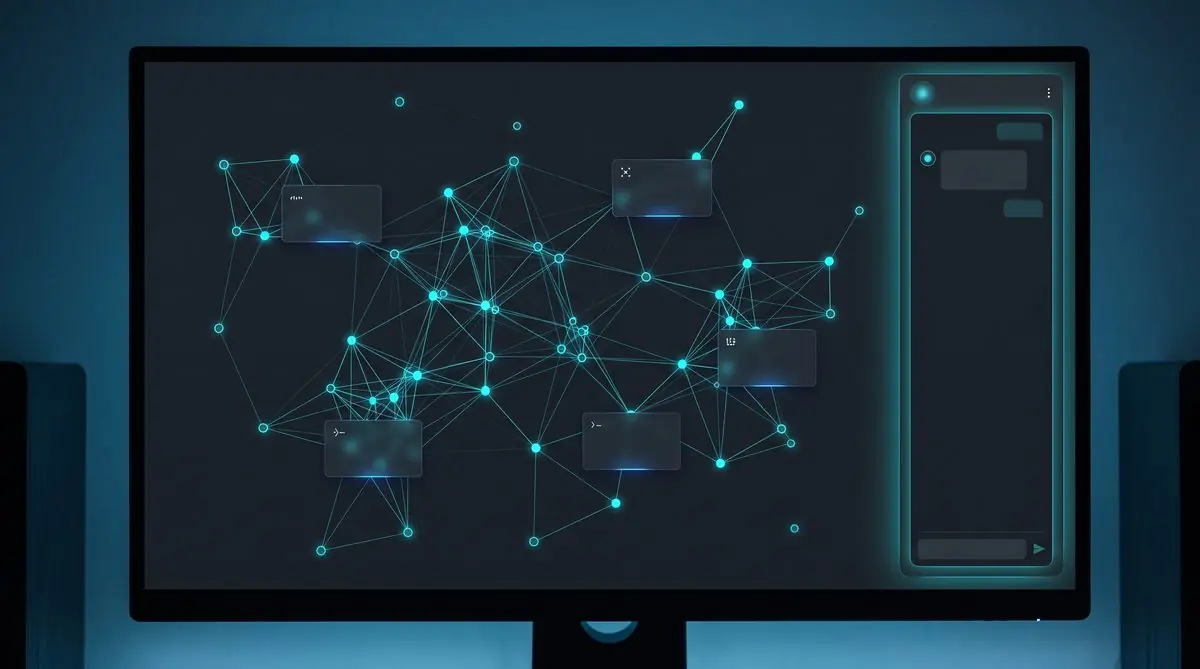
ConductLoop is a local-first "second brain" for people running multiple projects at once — a living memory graph plus AI agents that do work and write the result back into that memory. The hard constraint: everything private, running on the user's own computer, never on our servers. Here is how we shipped it.
The challenge
Most AI tools send your data to the cloud. ConductLoop's whole promise is the opposite: the memory graph, the local LLM and the agents all live on the buyer's machine. That meant packaging a full server into a desktop app and building a phone client that pairs to the user's own computer — no central backend.
What we built
- →Desktop app: a notarized Tauri build bundling a Python engine, memory graph and local LLM
- →iOS companion: a SwiftUI client that pairs to the user's own PC over the local network via QR
- →Licensing: a thin Cloudflare Worker + D1 license server so the paid app never exposes secrets
Result
A distributable, notarized desktop product with a paired mobile client — private by design, with zero data on our infrastructure. See it at conductloop.com.
Local-first is harder to build than a cloud SaaS, but for privacy-sensitive tools it is a genuine differentiator — and entirely achievable with the right architecture.
Keeping the product local
The local-first requirement changed the boundary of the whole product. In a conventional hosted app, the server can hold the database, run the model and connect each device. Here, the desktop computer has to do that work while still feeling like one coherent application. Packaging the Python engine, memory graph and local model together makes setup part of the engineering problem, not a task left to the user after downloading the app.
The phone companion follows the same principle. Pairing through a QR code gives the two devices a direct relationship without requiring a central account that could read the user's notes. That keeps the privacy promise understandable: the user's own machine stores the memory and runs the agents; the license service handles only the product entitlement.
This architecture asks more of the desktop app than a hosted service would. Updates, startup, local resource use and pairing all need to be considered together. The benefit is that private project context can remain on the computer where it was created, while the companion app makes that context accessible when the user is away from the desk.